Custom software development cost in 2026 spans an enormous range, from roughly $25,000 for a focused MVP to $5,000,000 or more for an enterprise-grade platform, and the figure that ends up on a proposal is decided far less by the software itself than by five measurable levers: scope, technology, compliance, team geography and engagement model. This guide lays out the real 2026 benchmarks, compares developer rates across the United States, Australia, Singapore and the major offshore hubs, explains which pricing model actually protects a budget, and surfaces the hidden costs that most vendor quotes quietly omit. It draws on the delivery experience of Hitek Software, a Ho Chi Minh City engineering house that has shipped fintech, healthcare, call-center and IoT products for clients across Korea, Australia and Japan. By the end, a decision-maker should be able to read any quote with confidence and avoid the common trap of paying two to ten times more than a project genuinely requires.
How much does custom software development cost in 2026?
The honest first answer is the one every experienced vendor gives: it depends. The useful answer is a set of tiers. Across global markets in 2026, the custom software development cost for most projects clusters into four predictable bands, and knowing where a project sits is the fastest way to sanity-check any estimate.
| Project tier | Typical 2026 cost | Timeline | Best fit |
|---|---|---|---|
| MVP / proof of concept | $25,000 – $80,000 | 2 – 4 months | Startups validating an idea, single core workflow |
| Small business / internal tool | $40,000 – $125,000 | 3 – 6 months | Departmental apps, process automation, light integrations |
| Mid-range platform | $125,000 – $300,000 | 6 – 12 months | Multi-role web or mobile products with real integrations |
| Enterprise-grade system | $250,000 – $5,000,000+ | 12 months and beyond | Regulated industries, large feature sets, robust infrastructure |
These bands reflect a market with strong underlying demand. Application development is projected to generate well over $195 billion in revenue in 2026, and the broader custom software market is forecast to reach hundreds of billions within the decade. That growth has two consequences for buyers: a deeper talent pool to choose from, and rising onshore rates that make team geography one of the single biggest cost variables.
A point most pricing guides bury is that a low headline number is not the same as a low total cost. A $50,000 project built by the wrong team on a vague scope can quietly become a $200,000 problem over two years, while a well-architected $150,000 build delivered by an experienced team can pay for itself inside twelve months. The cost of custom software development should always be read alongside what is being purchased, not in isolation.
Custom software development cost the world in 2026
What five levers actually determine custom software development cost?
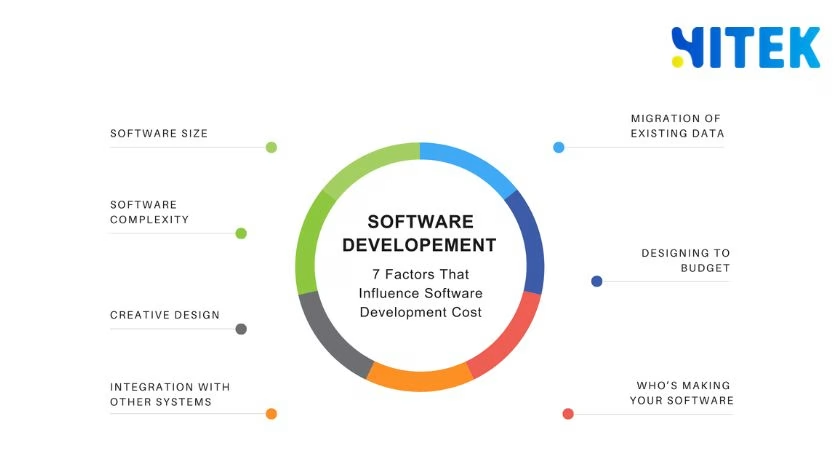
Rather than chase a generic list of cost factors, Hitek Software groups every estimate around what its delivery teams call the Five Cost Levers. Each lever can move a quote by a wide margin, and understanding them is what separates a buyer who negotiates intelligently from one who simply reacts to a number.
How do scope and complexity shape the estimate?
Scope and complexity are the dominant lever. A single-workflow tool with predictable screens behaves very differently from a platform with role-based permissions, real-time data, offline support and AI features. Complexity drives effort, and effort drives cost. As a concrete example, adding AI-powered capabilities such as predictive analytics or generative content typically increases custom software development cost by 10 to 20 percent on mid-to-large projects, because those features demand specialised engineering and longer testing cycles.
How much do technology and integrations add?
The technology stack and the number of third-party integrations form the second lever. Web applications remain the most common and generally the most economical platform, while native mobile apps with a custom backend, or desktop applications, each require different stacks and testing strategies. Every external system a product must talk to, whether a payment gateway, a mapping service or a hospital information system, adds integration and quality-assurance hours. Hitek has seen this firsthand across projects ranging from VoIP call-center platforms to BLE medical-device apps, where a single hardware or telephony integration can reshape an entire estimate.
Why does compliance change the math?
For regulated industries, compliance is a lever in its own right. Meeting standards in finance, healthcare or data privacy can add $30,000 to $150,000 to a base build, depending on the level of regulatory scrutiny involved. Security is not a line item to bolt on at the end; an annual penetration test alone runs $5,000 to $25,000 depending on scope. Treating compliance as an upfront design constraint, rather than a late-stage surprise, is one of the clearest markers of an experienced development partner.
How does team geography move the price?
Team geography is the lever with the widest swing, and it deserves its own section below. The same scope of work can cost three to five times more depending on where the engineers sit. This is precisely where a thoughtfully chosen offshore partner reshapes the entire custom software development cost equation.
Why does the engagement model matter?
Finally, the engagement model determines how risk and flexibility are shared between client and vendor. Fixed-price, time-and-materials and dedicated-team arrangements each allocate budget risk differently, and the wrong choice can inflate spend even when every other lever is optimised.
How do developer rates vary by region in 2026?
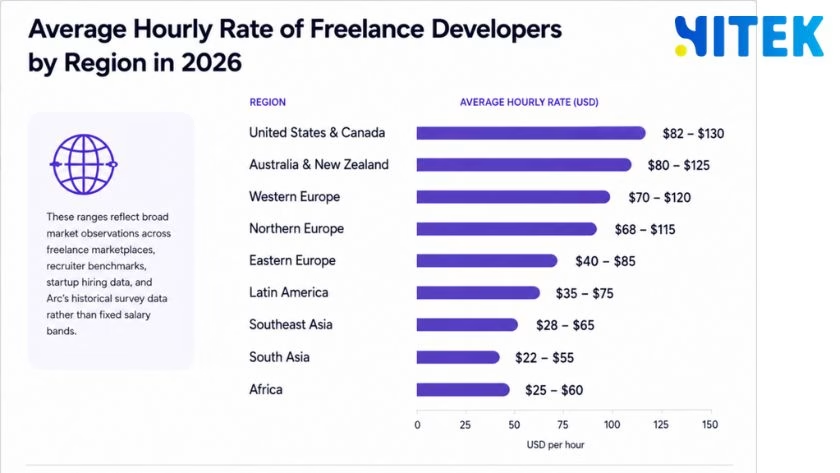
Because team geography is the heaviest lever, regional rate differences are the foundation of any serious budget conversation. The table below consolidates 2026 hourly rate data for mid-to-senior engineers across the regions most relevant to Australian, US and Singaporean buyers.
| Region | Blended hourly rate (2026) | Notes |
|---|---|---|
| North America (US / Canada) | $100 – $250 | Senior US developers frequently command $125 – $250+ |
| Australia & Western Europe | $50 – $199 | High local cost base; Western Europe averages around $66 |
| Eastern Europe | $19 – $70 | Strong price-to-quality ratio, average near $37 |
| Latin America | $13 – $61 | Time-zone alignment with the Americas, average near $50 |
| Southeast Asia (Vietnam, Philippines) | $20 – $50 | Lowest total cost with strong delivery consistency |
| South Asia (India) | $15 – $45 | Largest talent pool, more screening effort required |
The pattern is unmistakable. Offshore software development rates run 40 to 70 percent below onshore rates in 2026, and the gap is widest between North America and Southeast Asia. For a US, Australian or Singaporean company, that gap is the single largest lever available for reducing custom software development cost without reducing ambition.
Singapore deserves a specific note. As the technology hub of Southeast Asia, with technology spending projected near $28 billion in 2026, Singapore carries a high local cost of living and elevated local engineering rates. That is exactly why a growing share of Singaporean enterprises now treat offshore development not as a cost-cutting tactic but as a core strategic capability, frequently routing product work to nearby Vietnam for a consistent 30 to 50 percent cost advantage over other regional options.
Bar chart comparing 2026 blended developer hourly rates across North America, Australia, Eastern Europe, Latin America and Southeast Asia
Which pricing model protects a custom software budget?
Two projects with identical scope can produce very different invoices depending on the engagement model. Choosing correctly is a financial decision, not an administrative one.
| Pricing model | How it works | Budget behaviour | Best for |
|---|---|---|---|
| Fixed price | Total cost agreed upfront against a defined scope | Predictable, but scope changes trigger hidden charges | Small, well-defined projects with stable requirements |
| Time & materials | Client pays for actual hours and resources used | Flexible, but the final figure can drift above estimate | Evolving products built with agile methods |
| Dedicated team | A team works exclusively on the product, billed monthly | Stable monthly cost, easiest to forecast long-term | Long-running core products needing deep ownership |
The fixed-price model offers budget certainty and shifts execution risk to the vendor, which is attractive for predictable work. Its weakness is well documented: the moment requirements change, the fixed price reveals a hidden price tag through change requests. The time-and-materials model pairs naturally with agile delivery and accommodates change gracefully, at the cost of a budget that must be actively managed. The dedicated team model suits long-term products where requirements will evolve, giving the client predictable monthly costs and a team that develops genuine product ownership over time.
In practice, many of the most controlled budgets use a hybrid: a fixed, scope-controlled phase for the well-understood foundation, then a dedicated team or time-and-materials arrangement for the parts that need exploration. Hitek frequently recommends this blended approach because it balances the predictability buyers want with the flexibility that real product development demands.
What hidden costs inflate custom software development budgets?
The gap between a quoted figure and the true custom software development cost is almost always made up of expenses that never appeared in the proposal. The most commonly missed categories include:
- Ongoing maintenance, which typically runs 20 to 35 percent of the initial development investment every year and is the largest hidden cost of all.
- Third-party and infrastructure fees, including cloud hosting, API subscriptions, app-store charges and licensing.
- Security and compliance work, from penetration testing to audit preparation, especially in finance and healthcare.
- Project management and communication overhead, which grows sharply when an offshore team has poor time-zone alignment or weak English.
- Scope creep, the slow accumulation of small change requests that quietly outpaces the original estimate.
- Quality assurance and post-launch fixes, particularly when testing was treated as an afterthought rather than a parallel discipline.
A reliable way to plan for these is the Total Cost of Ownership lens: budget not only for the build, but for the two to three years of operation that follow. Vendors who raise these costs proactively are demonstrating exactly the trustworthiness a buyer should look for.
How does offshoring to Vietnam reduce custom software development cost?
For companies in Australia, the United States and Singapore, Vietnam has become one of the most effective ways to lower custom software development cost while keeping engineering quality intact. The numbers behind that claim are concrete.
Outsourcing to Vietnam costs roughly 55 to 70 percent less than building the same product in the United States. A mid-level Vietnamese developer working remotely for an international company costs in the region of $3,500 to $5,300 per month, against US salaries that often sit between $7,000 and $10,000 per month for comparable roles. The country fields a workforce of more than 550,000 engineers, produces tens of thousands of IT graduates each year, and benefits from a 0 percent VAT rate on software products, all of which keep the cost base low without compressing quality.
Cost, however, is only half the story. Vietnam’s GMT+7 time zone overlaps substantially with Australian business hours and aligns cleanly with the rest of the APAC region, which removes the communication overhead that erodes savings on far-offshore engagements. This is the lever that distinguishes a genuine partner from a cheap vendor, and it sits at the centre of how Hitek Software operates.
Hitek’s delivery model reflects this directly. The firm pairs high-calibre Vietnamese engineering with reasonable, transparent pricing, time-zone alignment that supports real-time collaboration with Australian and APAC clients, and cross-industry experience built across fintech wallets, BLE medical-device applications, VoIP call-center platforms and IoT integrations. Working extensively with demanding Korean and Japanese clients has shaped a delivery culture oriented around precise requirements, disciplined quality assurance and consistent communication, the same disciplines that protect a budget from the hidden costs described above.

Map graphic showing Vietnam’s GMT+7 time-zone overlap with Australia, Singapore and the wider APAC region
How can businesses control custom software development cost without sacrificing quality?
Controlling spend is less about negotiating a lower hourly rate and more about engineering the project so that money is spent on the right things. Four strategies consistently keep a custom software development cost on track.
- Start with an MVP, then expand. Launch a focused core product, gather real user feedback, and add features based on demonstrated value rather than assumption. A phased build often lands at $220,000 to $370,000 where a full upfront build of the same vision would reach $400,000 to $600,000.
- Lock the scope before locking the contract. The clearest single cause of budget overrun is mid-project change. Detailed requirements and wireframes turn a vague brief into an accurate estimate.
- Choose the engagement model deliberately. Match fixed-price to well-defined work and dedicated teams to evolving products, rather than defaulting to whatever a vendor proposes first.
- Use team geography as a strategic lever, not a last resort. Routing engineering to a time-zone-aligned offshore partner can cut the build cost by half while preserving, and often improving, delivery consistency.
The thread running through all four is the same: a knowledgeable partner who estimates honestly and raises risks early is worth more than the cheapest quote on the table.
Key Takeaways
- Custom software development cost in 2026 ranges from about $25,000 for an MVP to $5,000,000+ for enterprise systems, with most projects landing between $50,000 and $300,000.
- The figure is driven by the Five Cost Levers: scope and complexity, technology and integrations, compliance, team geography and engagement model.
- Team geography is the heaviest lever. Offshore rates run 40 to 70 percent below onshore rates, and Vietnam delivers 55 to 70 percent savings versus the United States.
- The right pricing model protects the budget; a blended fixed-price plus dedicated-team approach balances predictability with flexibility.
- Plan for hidden costs, especially maintenance at 20 to 35 percent of the build cost per year, using a Total Cost of Ownership view.
- A time-zone-aligned, multi-industry partner converts a low rate into genuinely low total cost.
For organisations in Australia, the United States and Singapore weighing the custom software development cost of their next product, Hitek Software offers a no-obligation cost estimate built around the Five Cost Levers and your specific requirements. Reach out to the Hitek team to turn a vague budget question into a clear, line-item plan, and to discover how a Ho Chi Minh City engineering partner with deep APAC and Korean-market experience can deliver the product you need at a cost that makes sense.