.svg)

Offshore software development has stopped being a cost-arbitrage tactic and become a standard way for companies to build engineering capacity they cannot hire locally. The shift shows up clearly in the data: in 2020, roughly seven in ten organisations named cost reduction as their primary outsourcing motive, and by 2026 that figure has fallen to about a third, with access to specialised talent and speed to market taking its place. That single change rewrites the entire buying process, because a decision made to save money is evaluated on rate cards, while a decision made to acquire capability is evaluated on engineering depth, governance and time-zone mechanics. This guide breaks down what offshore software development actually costs in 2026, which engagement model fits which kind of work, how to run technical due diligence on a vendor, and where the real failure modes sit. It is written from the delivery side, drawing on Hitek Software‘s eight-plus years of building production systems for clients in Australia, South Korea and Japan across fintech, medical devices, IoT and computer vision.
What is offshore software development, and how does it differ from nearshore and onshore models?
Offshore software development is the practice of contracting software engineering work to a team located in a different country, usually one with a materially different labour cost structure and often a significant time-zone separation from the client. The word that matters in that definition is location, not quality and not price. A team in Ho Chi Minh City building a payments app for a Sydney fintech is doing offshore software development; so is a team in Kraków building the same app for a New York bank. The commercial and operational consequences of those two arrangements, however, are completely different.
The industry generally splits geographic sourcing into three bands, and the boundaries are defined by time-zone overlap rather than by kilometres.
| Model | Typical time-zone gap | Overlap with client working day | Usual cost position | Best suited to |
|---|---|---|---|---|
| Onshore | 0 – 3 hours | Full | Highest | Regulated work requiring physical presence, or work with heavy in-person stakeholder dependency |
| Nearshore | 1 – 4 hours | Most of the day | Mid | Product work needing daily real-time collaboration and frequent scope negotiation |
| Offshore | 5 – 15 hours | Partial to minimal | Lowest | Well-specified product streams, dedicated long-run teams, platform and maintenance work |
The classification is relative to the buyer, and this is where most comparison articles mislead their readers. Vietnam is offshore for a company in Chicago, separated by twelve to fourteen hours. The same Vietnam is functionally nearshore for a company in Sydney, where the gap is three hours during Australian standard time and four during daylight saving. A single vendor can therefore sit in two different categories at once depending on who is buying, which means any offshore software development decision has to start with the buyer’s own geography rather than with a generic country ranking.
The third distinction worth naming is between offshore outsourcing and an offshore development centre. In the first, a vendor delivers a defined scope and owns the delivery process. In the second, the client effectively operates a remote extension of its own engineering organisation, with the vendor providing recruitment, employment, facilities and administrative infrastructure. The two arrangements produce very different governance obligations, and conflating them is one of the more expensive early mistakes a buyer can make.
Why has the reason for choosing offshore software development changed so sharply since 2020?
The motivation behind offshore software development has inverted in five years, and understanding why matters more than any rate table, because it determines what a buyer should be evaluating in the first place.
Three forces drove the change. The first is a persistent structural shortage of senior engineering talent in high-cost markets, concentrated precisely in the disciplines companies most need: cloud architecture, data engineering, machine learning and security. Industry estimates put the global cybersecurity workforce gap alone in the millions of unfilled roles. When a capability simply cannot be hired locally at any price within a workable timeframe, the offshore decision stops being financial and becomes existential to the roadmap.
The second force is the maturation of remote engineering practice. The tooling and process discipline that distributed teams were forced to adopt at scale in 2020 – asynchronous documentation, written decision records, trunk-based development with strong CI gates, observability as a default – turned out to be exactly the practices that make offshore software development work. Distance stopped being the primary obstacle it once was, because the coordination problem had been partly solved for unrelated reasons.
The third force is scope expansion. Functions that enterprises once considered too sensitive to outsource are now routinely externalised. Cybersecurity, which ranked among the least-outsourced IT functions as recently as 2023, has moved to the top of the list alongside infrastructure services in Deloitte’s survey data, with each cited by roughly 72% of respondents. Nearly half of outsourcing contracts now include AI and automation components. The work being sent offshore is no longer peripheral maintenance; it is core product and core infrastructure.
The practical consequence for a buyer is a change in the evaluation question. The old question was how much cheaper is this? The current question is can this team actually build and operate the thing, and can we govern it from a distance? A vendor selection process still anchored on hourly rate is optimising for the wrong variable, and it is the single most common reason offshore software development engagements disappoint.
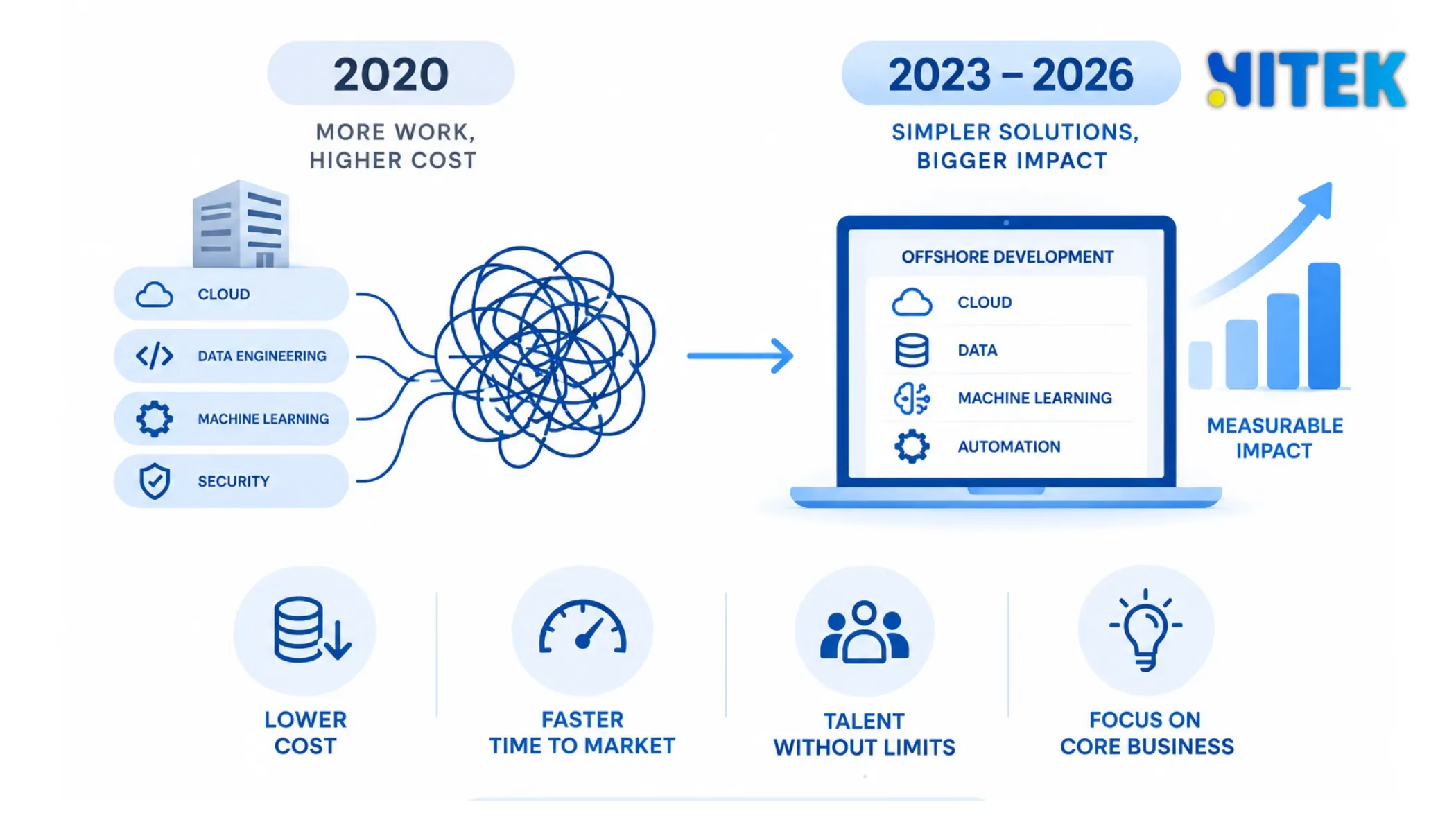
A two-bar comparison showing cost reduction as primary outsourcing driver, 2020 versus 2026, with the replacement drivers labelled alongside.
What do offshore software development rates actually look like in 2026?
Offshore software development rates in 2026 span roughly USD 15 to USD 150 per hour globally, and that range is so wide that the headline number is close to meaningless without decomposition. The figures below reflect blended agency or dedicated-team pricing rather than individual freelance rates, and they are drawn from published 2026 market surveys.
| Region | Typical hourly range (USD) | Character of the talent pool |
|---|---|---|
| South Asia (India, Bangladesh, Pakistan) | $15 – 45 | Largest volume pool globally; enormous quality variance between the low and high end |
| Southeast Asia (Vietnam, Philippines) | $20 – 50 | Growing senior depth; strong mobile, web and increasingly AI capability |
| Eastern Europe (Poland, Romania) | $35 – 70 | Senior engineering mid-tier; strong EU alignment and English |
| Latin America (Brazil, Colombia, Mexico) | $25 – 55 | Priced for North American time-zone overlap |
| Western Europe | $60 – 120 | No longer meaningfully described as offshore |
| United States onshore | $100 – 300 | Reference point rather than a sourcing option |
Two mechanics behind these numbers deserve more attention than the numbers themselves.
Why does the same country show a $30 spread in its rate band?
Because the country name describes the labour market, not the team. India’s published band runs from roughly $20 to $45 per hour, and that spread contains both high-volume body shops and engineering groups shipping production systems for Fortune 500 product organisations. Vietnam shows the same pattern within a $20 to $50 band. A buyer who reads the low end of a country’s range as the expected price is comparing against a market segment they almost certainly do not want to buy from.
The variables that actually move price within a country are seniority mix, domain specialisation, English fluency at the senior level, and whether the vendor carries delivery management as a billable or absorbed cost. A team of three mid-level developers at $22 per hour and a team of three senior engineers plus an embedded technical lead at $42 per hour are not competing offers; they are different products. Underlying salary data supports this: Vietnamese full-stack developers with real production experience command monthly compensation in the $2,200 to $5,000 range, and senior AI and data engineers considerably more, which sets a hard floor under any credible senior rate.
What is the loaded cost multiplier that no proposal shows?
The quoted hourly rate is not the cost of the engagement. Published analysis consistently puts the true landed cost of an offshore software development team at approximately 1.4 to 1.8 times the quoted rate once the surrounding expenses are priced honestly.
The components of that multiplier are predictable:
- Client-side management time. Someone internally owns specification, review, prioritisation and acceptance. That person’s loaded cost belongs in the model.
- Ramp-up. A new team is not productive on day one. Realistic ramp for a non-trivial codebase runs four to eight weeks, during which billing is full and output is partial.
- Attrition and knowledge replacement. Every departure carries a re-ramp cost, which is why vendor turnover rate is a financial metric rather than an HR curiosity.
- Rework from specification gaps. The most under-modelled line item. Ambiguous requirements executed at distance produce rework, and rework is billed.
- Tooling, licensing, security and compliance overhead. Access provisioning, audit requirements and data-residency arrangements all consume real time.
A budget built at 1.0× the quoted rate will overrun. A budget built at 1.6× and delivered at 1.35× is a well-run engagement. The discipline of modelling the multiplier explicitly, and asking a prospective vendor which components they absorb, separates buyers who succeed at offshore software development from those who are surprised by it.
Which engagement model fits which kind of work?
Four contracting structures dominate offshore software development, and the failure mode is almost always a mismatch between the model and the nature of the work rather than a defect in the model itself.
| Model | Commercial basis | Who owns delivery | Fits | Breaks when |
|---|---|---|---|---|
| Staff augmentation | Per-person monthly or hourly | Client | Filling named gaps in an existing team with its own process | The client has no engineering management capacity to direct the people |
| Dedicated team | Monthly team cost | Shared, vendor-led | Continuous product streams with evolving scope | Scope is genuinely fixed and finite |
| Project-based / fixed price | Fixed fee against defined scope | Vendor | Tightly specified, bounded deliverables | Requirements are still being discovered |
| Offshore development centre (ODC) | Monthly per-seat plus setup | Client, with vendor providing infrastructure | Long-horizon capability building, 15+ engineers | Headcount is small or the horizon is under two years |
The decision logic is more useful than the table. Fixed-price contracts transfer scope risk to the vendor, and the vendor prices that risk. If requirements are uncertain, that premium is paid regardless of whether the risk materialises, and every subsequent change becomes a commercial negotiation rather than a technical conversation. Conversely, a dedicated team model on genuinely fixed scope gives the client the flexibility they are paying for and no way to use it.
Staff augmentation deserves a specific caution. It appears to be the lowest-commitment entry into offshore software development, which makes it attractive to first-time buyers, but it silently transfers the entire delivery management burden to the client. An organisation without a technical lead who can write clear tickets, review pull requests and make architectural calls will get exactly the output that instruction quality permits. Buyers frequently choose augmentation to avoid vendor overhead and then discover they needed that overhead.
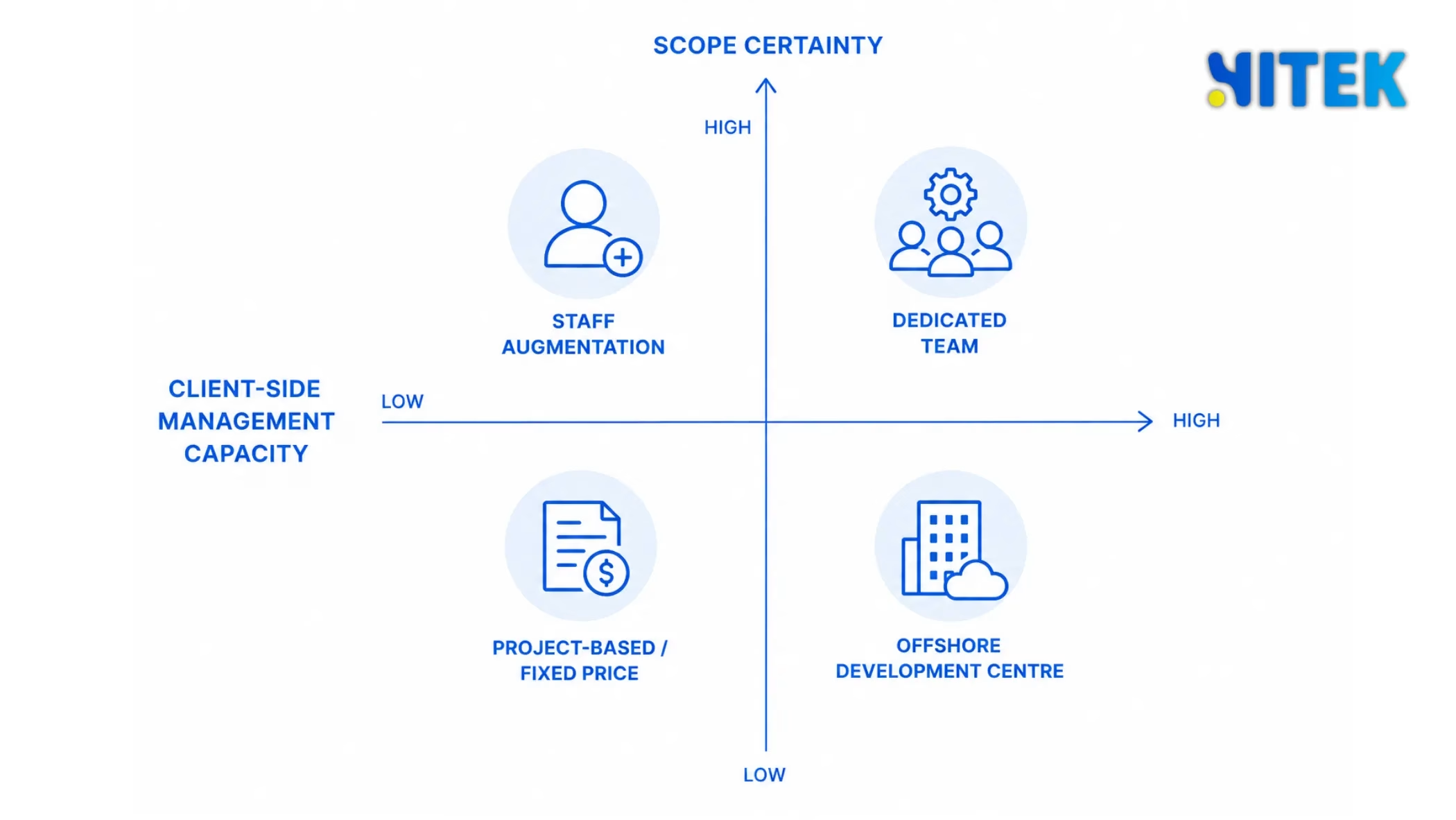
Four engagement models arranged against two axes, scope certainty on one and client-side engineering management capacity on the other
How Should a Buyer Evaluate an Offshore Software Development Partner?
Vendor evaluation in offshore software development is a technical exercise wearing a commercial costume. Sales presentations, client logos and certification badges correlate weakly with delivery outcomes. The evaluation that predicts results examines the engineering system a vendor actually runs and the governance the client will have over it.
What technical evidence should a buyer demand before signing?
Marketing claims are cheap; artefacts are not. A serious evaluation asks for things that cannot be manufactured for a sales cycle.
- A code sample from a comparable production system, released with client permission, reviewed by the buyer’s own engineer or an independent reviewer.
- The repository conventions. Branching strategy, review requirements, CI gates, and whether main is deployable. A vendor that cannot describe its merge policy in one sentence does not have one.
- Test coverage and its composition. A coverage percentage without a unit-integration-end-to-end breakdown says almost nothing.
- Named engineers with verifiable histories, not anonymised CVs. A vendor unwilling to name the people who will do the work is preserving the option to substitute them.
- A live technical conversation with the proposed technical lead, conducted without account management present. This single step surfaces more than any other item on the list.
- Incident history. How a team describes a production failure it caused reveals its engineering culture more reliably than any success story.
How is delivery governance established before work begins?
The contract determines what happens when the engagement goes badly, and offshore software development engagements are governed by what was agreed in advance rather than by goodwill.
Four provisions matter disproportionately. Source code ownership must vest in the client continuously, not on final payment, and the repository should sit under client-controlled infrastructure from the first commit. Intellectual property assignment must cover the individual engineers, not only the vendor entity, since employment law in the delivery jurisdiction governs the underlying assignment. Data handling terms should name the applicable regimes explicitly, Vietnamese vendors operate under the Law on Personal Data Protection, No. 91/2025/QH15, and stating the compliance basis is a signal of maturity. Finally, an exit provision should specify a documented handover with a defined transition period, because the cost of an undocumented exit is measured in months.
Named frameworks help buyers apply this consistently. Hitek Software’s internal evaluation approach, the Delivery Readiness Check, works through these dimensions in a fixed sequence, engineering system, people verification, governance, then commercial terms, specifically because buyers who evaluate commercials first tend never to reach the engineering questions.
What are the real failure modes of offshore software development, and how are they controlled?
Offshore software development fails in patterns, and the patterns are well enough documented that a prepared buyer can control for most of them. Anyone presenting the model as risk-free is describing a sales position rather than an operating reality.
| Failure mode | Early warning signal | Control |
|---|---|---|
| Specification gap | Clarifying questions arrive after implementation rather than before | Written acceptance criteria per ticket; a definition of done agreed before sprint one |
| Silent seniority substitution | The engineer in the interview is not the engineer in the standup | Named-engineer clauses; attendance at every sprint review |
| Tacit knowledge concentration | One person answers every question about a subsystem | Mandatory pair rotation; architecture decision records in the repository |
| Quality drift under deadline | Test coverage falls while velocity rises | Coverage as a CI gate, not a report |
| Turnover shock | Vendor declines to disclose annual attrition | Contractual overlap period on any replacement; retained knowledge documentation |
| Communication latency compounding | Blockers resolve in days rather than hours | Defined overlap window; escalation path with named owners and response times |
| Vendor lock-in | Only the vendor can deploy the system | Client-owned infrastructure and credentials; deployment runbook maintained as a deliverable |
The pattern across the right-hand column is worth stating plainly: every one of these controls is cheap to establish before an engagement begins and expensive to retrofit afterwards. The specification discipline that prevents rework, the coverage gate that prevents quality drift, the naming clause that prevents substitution, these are contract-drafting and process-design decisions made in week zero.
There is a second-order observation that experienced buyers eventually reach. Offshore software development amplifies whatever engineering discipline already exists on the client side. An organisation with clear requirements, working CI and a competent technical owner will get good output from a competent offshore team. An organisation with none of those will get its own ambiguity returned to it faster and in larger volume. Distance does not create dysfunction; it removes the informal corridor conversations that were previously concealing it.
How much time-zone overlap does an offshore engagement actually need?
Time-zone separation is the defining operational constraint of offshore software development, and it is routinely discussed in the wrong terms. The question is not how many hours apart the two locations sit, but how many hours of deliberate overlap the engagement is designed around and what work is scheduled inside them.
Practical thresholds emerge consistently from delivery experience:
- Four or more overlap hours supports real-time collaboration, including live pairing, synchronous design discussion and same-day blocker resolution. Scope can evolve inside a sprint.
- Two to three overlap hours supports a disciplined daily rhythm and requires that specification quality carry the rest of the day. Workable and common.
- Under two overlap hours requires genuine asynchronous engineering: written decision records, no verbal-only architectural agreements, and a deliberate handoff protocol at the end of each side’s day. Achievable, but only with process built for it.
- Zero practical overlap is not an offshore engagement; it is a sequential handoff arrangement, and it should be structured and priced as one.
This is where buyer geography changes the entire analysis, and where generic country rankings become actively misleading. Vietnam operates on Indochina Time, UTC+7. The gap to Australian Eastern Time is three hours during standard time and four during daylight saving, which places a Vietnamese team in the top overlap band for an Australian client, a full working morning of shared hours, every day, with no early starts or late nights required from either side. The same Vietnamese team sits twelve to fourteen hours from United States Eastern and Pacific time, which places the same engagement in the asynchronous band and demands a fundamentally different operating model built around a narrow early-morning window and structured end-of-day handoff.
Hitek Software’s delivery model was built around the Australian overlap specifically, and the honest framing matters: the three-hour gap is a genuine structural advantage for Australian and New Zealand clients, and it is not one that can be claimed for North American engagements. Buyers should treat any vendor claiming to have no time-zone gap with a US client as either careless or dishonest, and both are disqualifying.
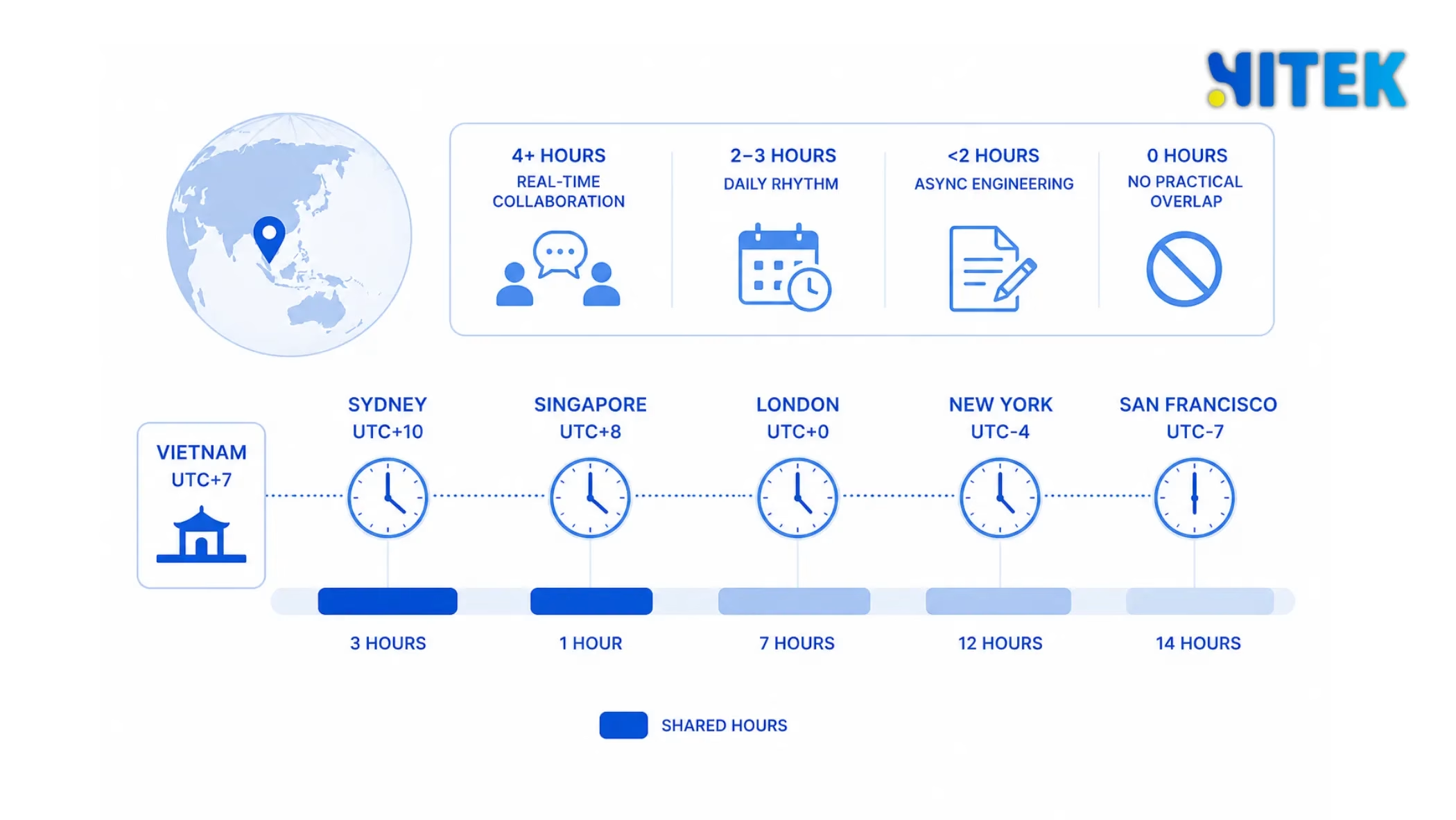
Vietnam working hours mapped against Sydney, Singapore, London, New York and San Francisco, with shared hours highlighted for each pair.
Where does Vietnam sit on the 2026 offshore software development map?
Vietnam has moved from a low-cost alternative to a mid-tier engineering destination over roughly a decade, and the supporting figures explain both the appeal and the constraints.
The talent base runs to approximately 530,000 to 600,000 working software developers within an ICT workforce exceeding 1.2 million, supplied by more than 150 universities and a substantially larger number of training institutions producing on the order of 50,000 to 60,000 new IT graduates annually. Published rates sit in the $20 to $50 per hour band. The workforce is young, with a tech-sector median age around the low thirties, which supports rapid adoption of current stacks but concentrates the shortage at senior level.
That last point is the honest constraint, and a buyer evaluating Vietnam for offshore software development should hear it from a Vietnamese vendor rather than discover it later. Vietnam has real depth in web, mobile, backend, QA and cloud work. The market tightens materially for roles requiring senior architectural ownership, advanced English at leadership level, deep AI and data specialisation, or platform engineering maturity. Vietnam’s own domestic demand competes for exactly these people, and the shortfall between supply and demand has been estimated in the range of 150,000 to 200,000 engineers annually in recent years. A vendor promising abundant senior AI architects at junior-market rates is describing something the labour market does not contain.
Where Vietnam competes strongly is the combination of four factors that rarely co-occur: rate levels well below Eastern European and Latin American mid-tiers, a genuine three-hour overlap with Australian business hours, comparatively low senior attrition relative to India’s largest hubs, and increasing vertical specialisation. Vietnamese vendors have concentrated depth in fintech, mobile applications, IoT and, more recently, applied computer vision and machine learning.
Hitek Software’s own portfolio maps to that pattern: cross-platform mobile delivery in Flutter for Australian fintech, medical device software with Bluetooth Low Energy diagnostics for Korean and Japanese clients, industrial IoT platforms, and production computer vision systems using current YOLO-family architectures for safety compliance and manufacturing defect detection. The Korean-market experience carries a specific operational implication that is unusual among Vietnamese vendors, Korean-language project management capability alongside English, which materially reduces the specification-translation loss that drives rework in cross-cultural engagements.
What does a Well-Run offshore engagement look like in the first 90 days?
The first ninety days determine the trajectory of an offshore software development engagement, and the pattern of a successful start is consistent enough to be planned against.
Weeks one to two (foundation). Access provisioning completes, the repository moves to or is confirmed under client control, the CI pipeline runs green on the vendor’s machines, and the overlap window and escalation path are agreed in writing with named owners. The vendor’s technical lead produces a written architecture summary of the existing system, and that document’s accuracy is the first real signal of engineering quality.
Weeks three to six (calibration). The team ships small, low-risk changes deliberately, so that the review loop, deployment path and definition of done are exercised on work where mistakes are cheap. Velocity is intentionally low and should not be read as a problem. What is being tested is the system, not the throughput.
Weeks seven to twelve (production rhythm). Sprint cadence stabilises, the team takes ownership of at least one bounded subsystem end to end, and the client’s management overhead should be measurably declining. Coverage and lead-time metrics establish a baseline.
Three signals at the ninety-day mark predict the eventual outcome reliably. Blockers should be resolving inside one overlap window rather than accumulating across days. Client-side management time should be falling, not holding steady, a team requiring the same supervision in month three as in month one is not learning the domain. And the vendor should be raising problems unprompted, because a team that only reports good news is either not looking or not telling.
Engagements that reach the ninety-day mark without these signals rarely recover through additional effort. They recover through structural change: a different engagement model, a different seniority mix, or a different vendor. Recognising that early is considerably cheaper than persisting.
Key Takeaways
- Start with buyer geography, not a country ranking. Vietnam is nearshore for Sydney and offshore for New York. The same vendor is a different proposition depending on who is buying, and generic destination league tables obscure this entirely.
- The quoted rate is not the cost. Budget offshore software development at 1.4 to 1.8 times the hourly rate to cover management, ramp-up, attrition and rework. A model built at 1.0× will overrun.
- Match the engagement model to scope certainty. Fixed-price transfers scope risk to the vendor and is priced accordingly; dedicated teams buy flexibility that fixed scope cannot use; staff augmentation quietly requires client-side engineering management.
- Evaluate the engineering system, not the sales deck. Code samples, merge policy, coverage composition, named engineers, and an unaccompanied conversation with the proposed technical lead predict outcomes. Logos do not.
- Design the overlap window deliberately. Two to three shared hours is workable with strong specification discipline; under two demands genuine asynchronous engineering. Any vendor claiming no time-zone gap with a US client should be disqualified on that basis.
- Establish controls in week zero. Continuous code ownership, individual-level IP assignment, named-engineer clauses, coverage as a CI gate, and a documented exit path all cost little upfront and a great deal to retrofit.
- Offshore amplifies existing discipline. Clear requirements and a competent technical owner produce good offshore outcomes. Their absence produces the client’s own ambiguity, returned faster and in larger volume.